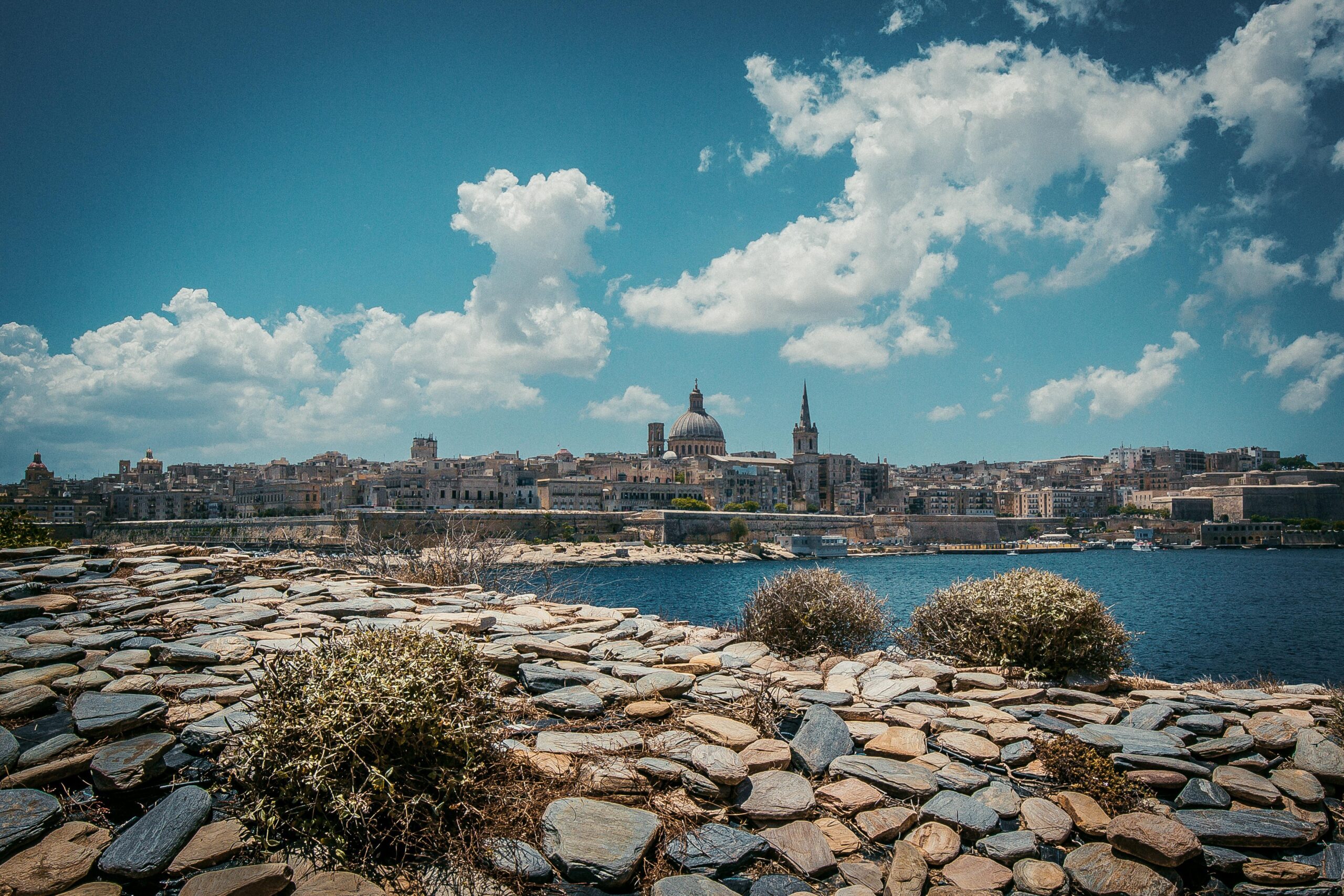
Malta looks tiny on a map, yet it feels far bigger once you’re on the island. In a single day, you can walk through walled cities built for war, watch the sea flash turquoise under limestone cliffs, and end up in a harbor where fishermen still unload the morning catch.
That mix is what makes Malta so hard to forget. Its history isn’t sealed behind museum glass, because it’s built into steep streets, church floors, old forts, tea habits, and the language people speak every day.
What follows is a journey through Valletta, Birgu, Mdina, Rabat, the Blue Grotto, and Marsaxlokk, with stops for sandwiches, pastries, and fresh seafood along the way.
Why Malta Is One of the Mediterranean’s Most Overlooked Destinations
Malta sits between Sicily and Tunisia, in one of the most contested stretches of the Mediterranean. The country is made up of three main islands, and the largest one, Malta, has nearly 200 kilometers of coastline shaped by cliffs, coves, caves, and working harbors.
Because the islands are small, the shifts in scenery feel almost unreal. One hour brings bastions and church domes. The next brings quiet farm roads lined with stone walls, then a fishing village painted blue and yellow by the sea.
Malta feels small on a map, but its history and scenery never do.
A crossroads of empires and sea routes
Few places show their past so plainly. Phoenicians, Romans, Byzantines, Arabs, Normans, Spanish rulers, the French, and the British all passed through or stayed, because Malta sat on sea routes that mattered to everyone.
You can still see those layers in the island’s daily life. Maltese has Semitic roots, yet the streets, churches, balconies, and food carry southern European and British traces. Even a short stay makes that blend clear. For a wider look at sites tied to that long past, Malta’s top historical sites gives a sense of how much history is packed into such a small country.
That wider Mediterranean role still feels current. Med.TV, a channel focused on the cultures of the region, is based in Malta, which suits an island that has linked Europe, North Africa, and the Middle East for centuries.
How Malta’s small size makes every journey feel personal
Malta’s scale changes the way travel feels. Distances are short, so there is little sense of being cut off from the next place. South to north can fit into a day, and inland drives are brief enough that the coast never feels far away.
As a result, the island feels intimate rather than overwhelming. You aren’t spending hours in transit. You’re moving from one piece of Malta’s story to the next.
Inside Valletta, Malta’s Fortress Capital
Valletta makes a strong first impression because it was built to do exactly that. The city rose under the Knights of St. John after they settled in Malta in the 16th century, and its plan still feels defensive, with steep streets, thick limestone walls, and commanding views over the Grand Harbour.
Even so, Valletta never feels severe for long. The sunlight softens the stone, and enclosed wooden balconies hang over narrow lanes in shades of green, blue, and red. Some look almost theatrical, while others feel domestic and worn in, as if they have watched the harbor for centuries.
British rule, which lasted about 150 years until independence in 1964, also left its mark. English is widely spoken, pub culture still has a place here, and tea with milk doesn’t feel out of character. World War II damaged parts of the city because Valletta was tied to a British naval base, but careful rebuilding preserved its old form.
St. John’s Co-Cathedral and the glory of the Knights
St. John’s Co-Cathedral captures the shock of Valletta better than almost anything else. From the outside, it looks restrained. Step inside, and the space turns rich and bright, with gold-covered walls, painted ceilings, and marble tomb slabs spread across the floor like a stone patchwork of memory and status.
The cathedral also explains the Knights of Malta in visual form. Their eight-pointed cross appears throughout the church and later became one of Malta’s best-known symbols. Side chapels connect to the different groups within the order, and each one is filled with ornament, painting, and pride.
Then there is Caravaggio’s The Beheading of St. John the Baptist. It anchors the space with drama and shadow, and it gives the church one more layer of gravity.
Local food, daily life, and the charm of a city that still feels lived in
Valletta isn’t only monuments. It still hums with small routines, and food is part of that rhythm. One local classic is a crusty hobz biz-zejt style sandwich piled with tuna, beans, tomatoes, olives, capers, peppers, and olive oil, the kind of meal that tastes even better by the sea.
That lived-in feeling also comes through in the back streets. Elderly locals sit in old cafes, conversations spill toward the pavement, and the city feels used rather than staged. Even the balconies tell part of the story. Their enclosed form hints at Arab and southern European influence, yet they are now one of Valletta’s clearest signatures.
Upper Barrakka Gardens and the best harbor view in the city
Upper Barrakka Gardens is where Valletta’s beauty and strategy meet. The gardens sit high above the Grand Harbour, framed by arches and Mediterranean greenery, and the view explains at a glance why Malta mattered so much to naval powers.
Across the water lie the Three Cities, with Birgu at the center of the scene. You can picture the ships of the Knights and later the British filling the harbor below. Once you see that sweep of water, bastions, and stone towns, Malta’s military history stops feeling abstract.
Birgu, Fort St. Angelo, and the story of Malta’s greatest siege
One of the best ways to reach Birgu is by boat at sunset. Traditional wooden harbor boats still cross the Grand Harbour, although most now use motors, and the short ride gives the city the right entrance. Limestone walls rise from the water, Fort St. Angelo pushes into the sea, and the whole harbor feels built for history.
Birgu was the early base of the Knights before Valletta took shape, and it still carries that older mood. The streets are tighter, the pace is slower, and the harbor edge feels close to daily life.
The Great Siege of 1565 in simple, dramatic terms
Fort St. Angelo mattered because whoever held this harbor held one of the central points of the Mediterranean. In 1565, that fact turned Malta into the site of one of the era’s fiercest battles, when a huge Ottoman force attacked the island and the Knights, local fighters, and soldiers tried to hold it.
The numbers alone make the story striking. Accounts place the attackers at more than 40,000 men, facing a far smaller defending force of about 8,000 soldiers and 700 knights. After months of brutal fighting, Fort St. Angelo and the island held.
Standing above the harbor today, the scale of that struggle becomes easier to grasp. The sea looks calm, but the setting tells you why so many powers wanted Malta.
Why the Three Cities still matter today
Birgu and the neighboring harbor towns keep Malta’s older character close to the surface. They are quieter than Valletta, yet they reveal just as much, with old stone houses, church domes, boat landings, and lanes that still feel shaped by the sea.
These places also widen the island’s story. Malta is not only its capital. The Three Cities show the harbor world that existed before Valletta rose, and they make the island’s long past feel lived in rather than distant.
Mdina and Rabat, where Malta’s oldest layers still shine through
About 25 minutes inland, Malta changes again. Mdina sits on high ground behind thick limestone walls, and the approach alone gives it a hushed, almost suspended feeling. People lived in this area from the Bronze Age onward, and the Phoenicians later fortified the hilltop because it offered strong views across the island.
Mdina was Malta’s capital long before Valletta. After the Knights shifted power toward the harbor towns and later to Valletta, Mdina kept its old dignity. Its main gate also found a second life on screen as an entrance to King’s Landing in Game of Thrones.
Just outside lies Rabat, whose name comes from the Arabic word for “suburb.” If Mdina feels aristocratic and still, Rabat feels local and busy. The contrast makes visiting both places in one stretch especially satisfying.
Walking Mdina’s narrow streets feels like stepping back in time
Inside the walls, Mdina glows. Limestone facades catch the sun, St. Paul’s Cathedral rises above the lanes, and quiet side streets pull you away from the small squares into a calmer world of balconies, courtyards, and polished doorways.
Some of the most memorable details are small. Brass door knockers shaped like lions, fish, and other figures hint at old trades, family status, and the social codes that once shaped city life. At Bastion Square, the mood opens up. The walls give wide views across Malta and out toward the Mediterranean, which is exactly why this hilltop city remained important for so long.
Why Rabat feels like the island’s everyday heart
Rabat brings things back to street level. Cafes are lively, counters fill with pastries, and breakfast has a strong local pulse. Pastizzi are the stars, flaky and hot, usually filled with ricotta or mushy peas. They are salty, rich, and far more satisfying than their humble look suggests.
Qassatat add another layer, with a sturdier pastry shell and fillings such as ricotta. Pair them with tea made with milk, and British influence slips into the picture again. Yet the pea filling, the spice, and the pace of the cafe feel close to Malta’s southern neighbors too.
Malta’s coastline, caves, and fishing villages are just as impressive as its cities
Malta’s stone cities get most of the first praise, but the coast is just as striking. Drive beyond the walls and the island opens into farm plots, low stone boundaries, rocky slopes, and sudden views of the sea. Then the shore breaks apart into caves, harbors, and cliffs that look carved by light.
Guides such as 100 things to do in Malta make more sense once you see how much variety fits into one island.
The Blue Grotto and the island’s brightest water
The Blue Grotto is one of Malta’s strongest natural scenes. Huge limestone cliffs drop into clear water, and a broad cave opening cuts into the rock like a giant arch.
Sunlight is the reason the place has its name. When the light enters the cave at the right angle, the sea shifts through electric shades of blue and turquoise. Even in partial shade, the color looks unreal.
Marsaxlokk’s fishing boats, market energy, and sea-to-table life
Marsaxlokk shows a more traditional side of Malta. The harbor fills with luzzu boats painted in bright blues and yellows, and many carry painted eyes on the bow. That custom goes back to ancient seafaring beliefs and is often linked to Phoenician tradition, with the eyes meant to protect fishermen at sea.
On Sunday, the village turns into a fish market. Octopus, clams, mussels, sardines, mullet, tuna, crabs, and shellfish crowd the stalls, and the smell of the catch tells you it did not travel far. A Tunisian local at the market pointed out how familiar some of the language and food can feel, which says a lot about Malta’s ties to North Africa. Lunch by the harbor drives the point home, especially with fried calamari, large prawns, tartar sauce, and a cold Cisk beer.
Why Maltese food says so much about the island’s history
Maltese food speaks in the same mixed accent as the island itself. A tuna and bean sandwich belongs to the Mediterranean shore. Tea with milk hints at Britain. Ricotta pastries feel close to Italy, while pea-filled pastizzi can echo flavors that reach toward North Africa and beyond.
From pastizzi to fish fries, the island eats with personality
Nothing about Malta’s food feels polished for show. It is salty, crisp, oily in the right way, and built for appetite. Pastizzi shatter when you bite into them. Qassatat are denser and fuller. Fried calamari and prawns arrive golden and simple, and they don’t need much more than lemon and a beer.
A food culture shaped by sea, trade, and family habits
Because Malta is surrounded by water, seafood lands at the center of daily meals. Because the island traded with so many neighbors, familiar flavors keep turning up in new forms. And because the country is small, old habits survive more easily, whether that means buying fish on a Sunday morning or stopping for pastries before work.
What stays with you after Malta
Malta’s strongest pull is the way so many things sit close together without blurring into one another. Valletta feels martial and grand. Birgu feels older and more intimate. Mdina turns inward and hushed, while Rabat comes alive through pastry counters and everyday routine. Then the coast opens up, and the whole island flashes blue.
That is why Malta lingers in the mind. Its beauty isn’t only in one cathedral, one fort, or one bay. It comes from the meeting of old stone, bright water, and a past that still shapes ordinary life.
For such a small country, Malta leaves a long trail of images behind it. And even after Valletta, Birgu, Mdina, the Blue Grotto, and Marsaxlokk, there is still Gozo, Comino, and the Blue Lagoon waiting offshore.