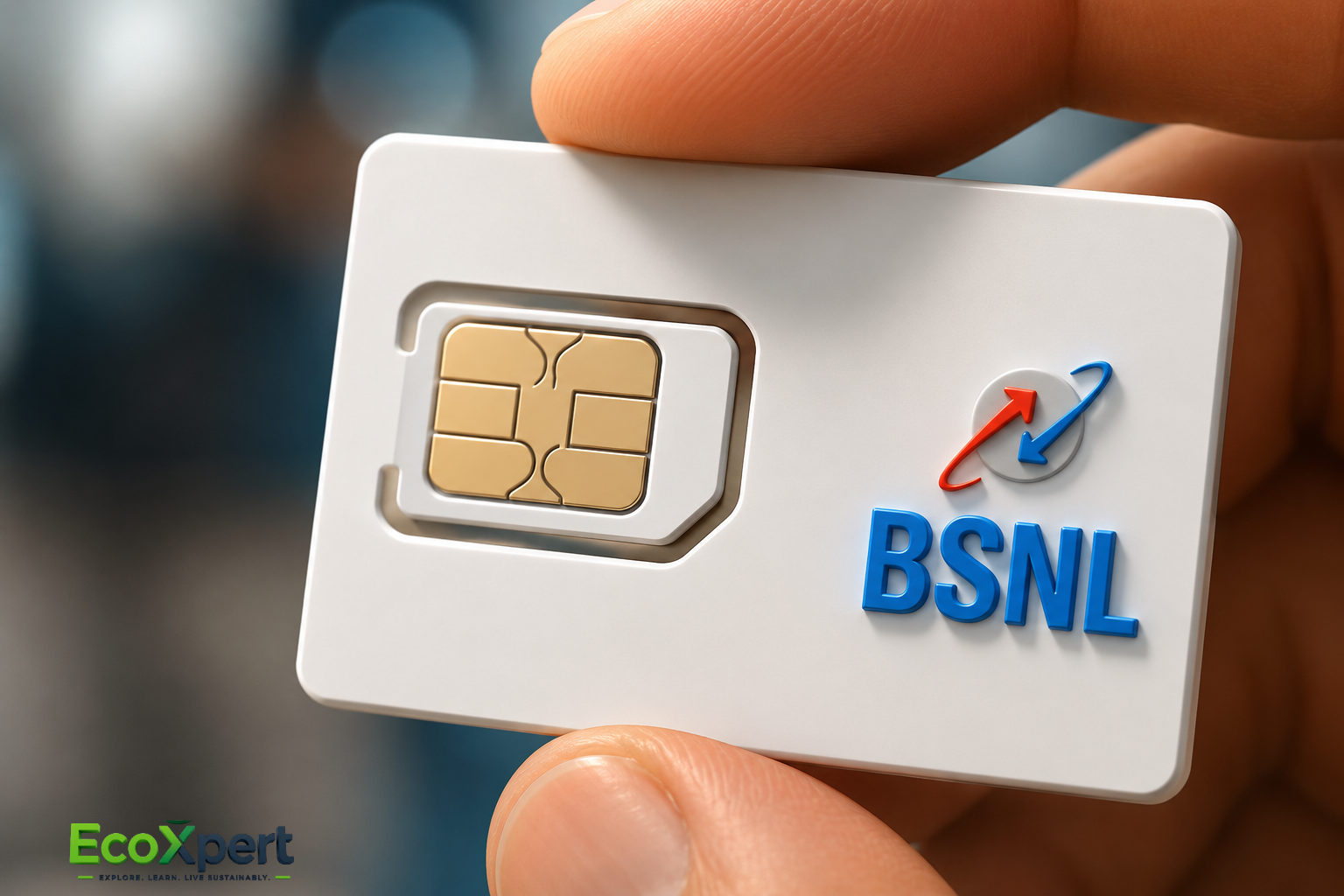
A BSNL SIM now costs Rs 1 for new users or number porting, and that headline is enough to make people look up from their Jio and Airtel bills. Add fresh profit news and low-cost recharges, and the old state-run carrier suddenly feels relevant again.
But mobile plans are easy to sell on paper. Daily phone use is where the story turns, because cheap data means little if your maps stall in traffic or calls drop when you need them most.
That is the only question that matters in 2026, and the answer starts with the offer that pulled people back to BSNL.
What BSNL is offering right now, and why people noticed
BSNL has momentum again because it is selling hope and savings at the same time. For users tired of rising prices from private carriers, that is a strong hook.
The Rs 1 SIM offer and cheaper plans on paper
The headline offer is simple. If you are getting a new BSNL SIM or porting your number, the SIM costs Rs 1, there is no recharge required upfront, and you get one month of free data. For anyone curious about BSNL, that makes trying the network feel almost risk-free.
The bigger reason people are talking about BSNL, though, is the tariff gap. Many of its plans are far cheaper than similar packs from Jio and Airtel. That matters because telecom bills have started to feel less like a utility and more like a subscription that keeps creeping up.
The price gap is easiest to see side by side.
| Plan type | BSNL | Jio / Airtel comparison | What stands out | | | | | | | New SIM or port | Rs 1 SIM, one month free data | Usual upfront SIM and recharge costs | Very cheap way to test the network | | Daily data plan | Rs 225 for 2.5GB per day | Jio around Rs 399, Airtel around Rs 429 for similar use | BSNL is close to half the price | | Mid-term plan | Rs 997 for 2GB per day for 5 months | Roughly 3 months for a similar spend | Longer validity for less money | | Annual plan | Rs 2,000 for 1.5GB per day, Rs 2,400 for 2GB per day | Jio and Airtel around Rs 3,600 | Big savings over a full year |
That is the pitch in one glance. BSNL is the budget choice by a wide margin. The catch is that the network does not give the same reliable, unlimited-feeling experience many users now expect from 4G and 5G service.
How to buy a BSNL SIM and what activation looks like
Getting a BSNL SIM still feels old-school. The SIM can be bought from a BSNL office, and it is also available through post offices. Some users will like that no-frills process. Others will notice how different it feels from the polished storefronts and instant onboarding of private carriers.
The setup itself is not hard. In this case, the SIM activated the next day, which is a fair turnaround. That is also the moment when expectations start to rise, especially if you live in a major city and assume 4G will be there from the start.
That assumption is where the smooth part ends. Buying the SIM is easy enough. Living with the network is the real test.
What it is actually like to use BSNL in NCR every day
In Noida, Delhi, and Gurugram, the experience often felt stuck in another era. The phone screen looked connected often enough, but the connection behind it was another matter.
Why 3G and 2G still matter in 2026
The first shock was how often the phone sat on 3G, H+, or even 2G. H+ sounds modern because of the plus sign, but it is still old 3G with a cleaner label. In 2026, that changes everything.
Apps today assume steady 4G at minimum. Reels need quick bursts of speed. YouTube needs room to buffer. App stores and game downloads expect the network to hold still for more than a minute. On BSNL in NCR, those basic tasks often slowed to a crawl or failed outright.
That gap showed up fast in side-by-side use against Airtel and Jio. Speed tests were not close. Reels lagged or never loaded. YouTube buffered. Downloads took far too long. At times, the network would drop so far that the phone became little more than a slab of glass with a battery inside.
Some spots did show a 4G icon, but those moments were rare. Most of the time, the experience felt like borrowing a connection from an older decade and hoping modern apps would be polite about it.
Call quality, roaming alerts, and everyday failures
Data problems were only half the pain. Calls were shaky too, with low audio quality and delay that made conversations feel out of step. It seemed closer to older 2G voice service than the cleaner VoLTE calling people now take for granted.
The stranger part was how unreliable the phone felt even when it claimed to have service. There were stretches with “emergency calls only.” At other times, the screen showed signal bars, yet nothing worked. Maps would stop in the middle of traffic. Music would not play over CarPlay. A phone that cannot load navigation in a jam is not a small inconvenience. It is a daily failure.
Gurugram added another odd twist. The phone sometimes showed roaming, even though the SIM had been bought in the same broader NCR region. That kind of alert chips away at trust because it makes the network feel confused inside its own footprint.
The worst moments were the simplest ones. You dial, and the phone says “call ended.” You try again. Same result. For work, travel, or urgent calls, that is hard to excuse.
The surprise: BSNL can work better in some smaller towns and remote spots
BSNL is not equally bad everywhere. In fact, the most positive part of this test happened away from the NCR glass towers and traffic lights.
When BSNL 4G actually felt usable
Across parts of Uttar Pradesh, including routes through Kanpur, Prayagraj, smaller towns, and highways, BSNL started to look more promising. In one remote village, the network showed proper 4G and behaved like it. Reels and Shorts played fine. That alone felt like a different company.
In a nearby city market, speeds reached close to 20 Mbps. That is not top-tier performance, but it is enough for normal phone use. Apps downloaded. Social feeds loaded. Even BGMI, which is harsh on weak networks, was playable, though the ping stayed high.
That matters because it shows BSNL is not broken in every corner. It can work. In some places, it works better than many urban users would expect. There is still a trace of the old belief that BSNL can show up on highways, in villages, and in spots where private networks weaken.
Yet a few good pockets do not turn a patchy network into a trustworthy one.
Why one good day does not build trust
The real problem is not that BSNL never works. The real problem is that it does not work the same way twice.
A location that gave stable 4G one day could fail the next day without warning. The icon would still say 4G, but nothing would load. That kind of inconsistency is worse than a clearly weak area, because the phone keeps making promises the network cannot keep.
Calls suffered from the same issue. Outgoing calls would end at once. Incoming calls could fail too, even while the screen still showed 4G. That is the sort of mismatch that kills confidence fast. A strong signal icon means little if the call never rings through.
Try BSNL as a backup SIM, not as the number you cannot afford to miss.
That is the line the network kept drawing. Usable in bursts, frustrating in between, and too unstable for blind trust.
Can BSNL really compete with Jio and Airtel in 2026?
For price, BSNL has a case. For everyday dependability, Jio and Airtel still feel miles ahead.
Price is BSNL’s biggest strength, but not enough on its own
BSNL wins the tariff fight with ease. If your main goal is to cut your monthly bill, it is the obvious budget option. That makes it appealing for students, light users, and anyone who wants a second SIM for extra data or travel.
But telecom is one of those services where the cheapest option can become the most expensive in other ways. Lost time matters. Failed calls matter. Broken maps matter. A missed OTP, a dead payment app, or a dropped call during travel can erase the savings in a single bad afternoon.
That is why daily experience matters more than the recharge chart. Broader studies such as the India mobile network experience report are useful because they focus on what users feel, not only what carriers advertise. On that front, BSNL still feels unfinished.
So yes, price is its biggest strength. It is also the reason many people will keep testing it. Still, price alone cannot carry a main SIM card.
Why Jio and Airtel still feel safer, and why the 5G comeback talk rings hollow
Jio and Airtel feel safer because they do the boring things better. Calls connect. Maps open. Music streams in traffic. The phone works in the background without asking for patience. That is what most people want from a primary number.
BSNL’s 5G story also remains thin. The one-rupee SIM was framed as “5G-ready,” but that does not mean a real, live BSNL 5G experience is waiting on the other side. According to RCR Wireless coverage of BSNL’s 5G timeline, the company plans to move to 5G only after its 4G network is stabilized. That makes sense technically. It also confirms the ground reality. The 5G hype arrived before the 4G experience felt settled.
For most people, that leaves Jio and Airtel in the safer lane. They cost more, but they still inspire more trust for work, travel, payments, and emergency use.
The bigger comeback question
BSNL has better headlines than it had a few years ago. That does not mean the comeback is complete.
Profits are back, but the network turnaround is not
The financial news sounds encouraging. BSNL has posted roughly Rs 25,000 crore in revenue, and one widely cited figure, often described as EBITDA, reportedly climbed from about Rs 50 crore to Rs 7,000 crore in two years. It has also posted profits in recent quarters, which is a genuine shift in tone.
Still, money headlines and user experience are not the same thing. BSNL came late to 4G, while private rivals had already pushed ahead with 5G. That delay still hangs over everything. A cheaper SIM can bring curiosity back, but curiosity fades fast when the network stalls on a city road.
Trust also takes more than a good quarter. Criticism around execution, including claims of billing lapses and questionable spending decisions, makes people wonder whether new revenue will turn into a better network any time soon.
What the market-share numbers say
The market share picture is still small. BSNL sits near 7% of the market based on the figures discussed here. If only about six in ten BSNL SIM holders are actively using their line, the effective share drops closer to 4%.
User additions tell the same story. BSNL reportedly added about 76,000 people in April, while Airtel added about 31 lakh in the same month. That is not what a full comeback looks like.
There is still a real opening for BSNL. Many users want a cheaper carrier that works well enough to break the Jio-Airtel duopoly in their wallet. The demand is there. The network still needs to catch up to it.
The verdict on BSNL in 2026
BSNL has one clear advantage in 2026, and that is price. If you want a low-cost second SIM and your area happens to have decent coverage, the risk is small enough to try.
For a main number, the answer is still no. The network can swing from usable 4G to dead air too quickly, and the call experience is too weak for work, travel, or emergencies.
That makes reliability the whole story. BSNL has the opening, the attention, and the bargain plans. What it still does not have, at least not in a wide and dependable way, is the trust to replace Jio or Airtel on your primary phone.