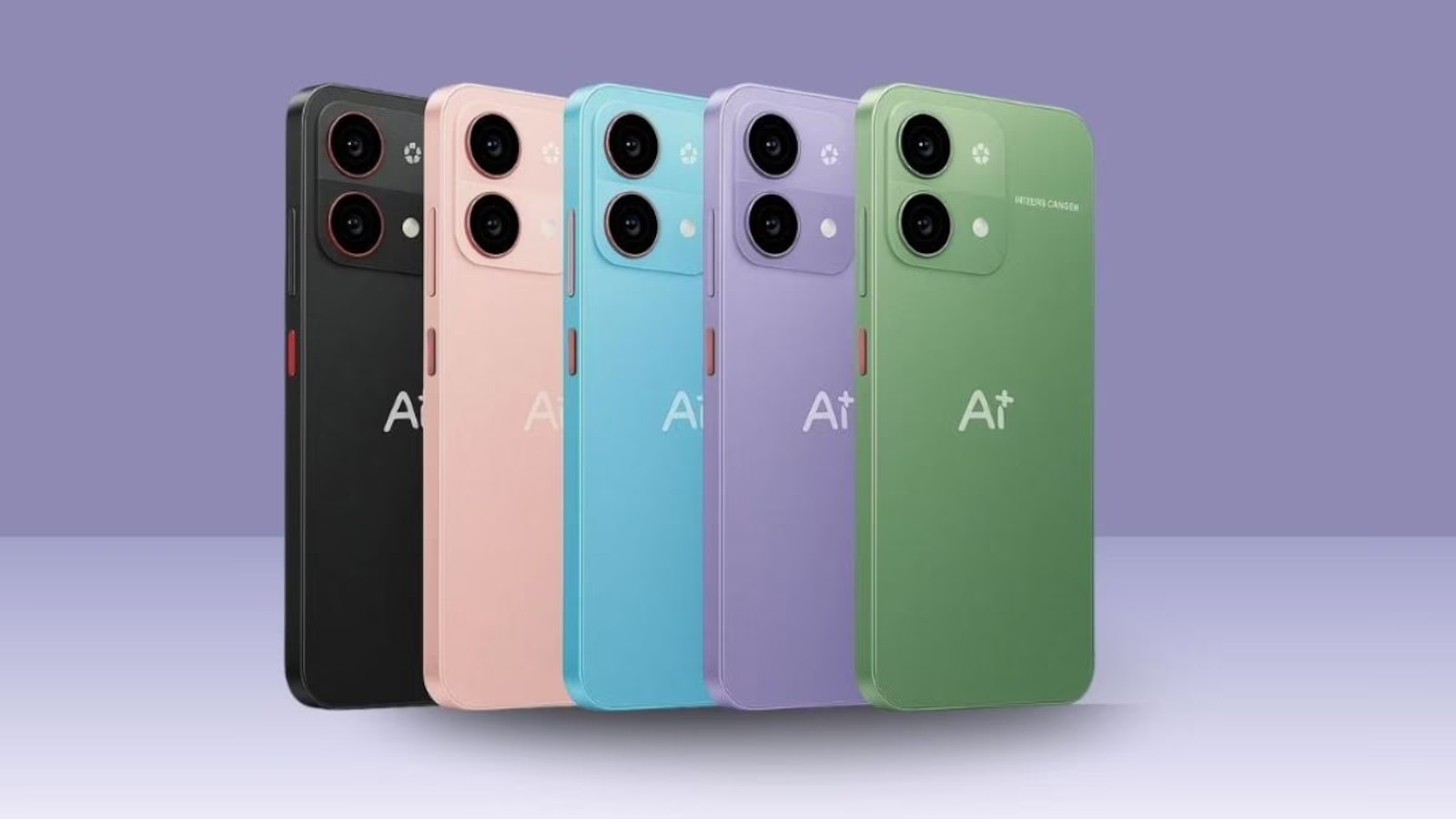
A cheap smartphone launch turned into a fight over who gets to speak. That is the heart of the AI+ story, and it is why this case traveled far beyond spec sheets and launch slides.
Mrwhosetheboss’s investigation showed a brand selling “India-first” privacy and patriotism, while reviewers kept finding signs of Chinese software, Chinese hardware partners, and marketing claims that did not hold up. Then the company tried to silence that criticism in court.
Why AI+ looked like the Indian phone brand many wanted
India is the world’s second-largest smartphone market, with more than 700 million users. Yet a large share of those phones, roughly two-thirds by the video’s estimate, still come from Chinese brands such as Xiaomi, Vivo, and Oppo. That gap created an opening for a company to say, “We can build something Indian, keep data in India, and give buyers a reason to choose local.”
AI+ arrived in July 2025 with that exact pitch. It called its phone India’s first “fully sovereign smartphone.” The company said it was engineered and built in India, that user data would stay in India, and that online data would sit in Google Cloud India regions. On the boot screen, the promise was even simpler:
“Your data stays safe in India.”
That message was everywhere. AI+ did not treat “Made in India” as a small detail. It made it the whole identity of the brand. The company also said its phones were secure enough to be “certified for government,” and CEO Madhav Sheth publicly criticized rivals for depending on software and updates from abroad.
That framing mattered because Sheth knew the market. He had held senior roles at Oppo, helped build Realme into one of India’s biggest phone brands, and later led Honor India and Alcatel India. Few people in the country had a stronger smartphone resume.
The prices made the pitch even sharper. The AI+ Pulse started at 4,499 rupees, while the Nova 5G started at 7,499 rupees. For buyers, the promise sounded almost too good: low-cost phones, national pride, local data, and freedom from the concerns tied to foreign brands.
The trouble started when reviewers looked under the surface.
The first reviews found Chinese apps behind Indian privacy claims
One of the first major cracks came from Gyan Therapy. In his review, he said AI+’s “Next Quantum OS” looked a lot like software from Realme, the brand Madhav Sheth once ran. That similarity did not prove copying on its own, but it raised an obvious question. If this was a fresh software skin for a fresh company, why did it look so familiar?
Then came the bigger problem. Gyan Therapy found three preinstalled apps that users could not remove or disable: Clean Assistant, Phone Clone, and Mobile Butler. On Maini’s own device, one of those later appeared as Phone Manager.
The issue was not that the apps existed. Most phones ship with extra software. The issue was that AI+ had spent months promising Indian control, Indian data handling, and Indian privacy. Yet the privacy policy for Phone Clone named a China-based company, Sprocomm Technologies, as the service provider. Maini later shared a Sprocomm privacy policy clip that showed why reviewers were alarmed.
This was the core conflict:
| App or feature | What reviewers found | Why it mattered |
|---|---|---|
| Phone Clone | Privacy policy named Sprocomm Technologies in China | It clashed with claims that data stayed in India |
| Clean Assistant | Preinstalled and non-removable | It looked like hidden third-party software |
| Mobile Butler / Phone Manager | Preinstalled system utility tied to the same software family | It suggested the OS had outsourced pieces beneath the surface |
Maini also sent the app files to an Android researcher, who said the apps looked Chinese-built and had been renamed to appear native to Next Quantum OS. That claim did not prove misuse of personal data. It did, however, weaken AI+’s clean story about sovereignty and local control.
After that review, Gyan Therapy received a legal notice and his video was geo-blocked in India. For a phone review, that was already a startling move. It soon got worse.
A second product wave turned suspicion into a full scandal
The investigation widened from software to hardware. Maini noticed that phones shown on Sprocomm’s site looked strikingly close to AI+ hardware, especially in camera layout, body shape, and listed specs. That pointed to a common industry model: the ODM, or original design manufacturer.
Why the ODM question mattered
A contract manufacturer builds a product from another company’s design. An ODM often designs the product too, then sells variations of it to brands that add their own logo and minor tweaks. There is nothing unusual about using an ODM. The problem comes when a company sells that product as if it imagined and built the whole thing itself.
Maini also spoke to a senior source in the Indian supply chain, who described Sprocomm as a low-tier ODM. According to that source, low-tier ODMs cut costs hard, do little original R&D, and may rely on weaker quality control. The source even claimed that some cheap devices in this part of the market can use secondhand components, including storage chips. That was an insider claim, not a lab finding on every AI+ unit, but it made AI+’s supplier choice look worse, not better.
Then came AI+’s second wave in 2026. TechWiser reviewed the Pulse 2 and called it a “marketing disaster.” One reason was bloatware. Sheth had promoted AI+ phones as bloatware-free, yet Maini and other reviewers found a hidden game hub loaded with preinstalled games and ads. Another reason was even more serious: TechWiser said the same Chinese-linked apps from the first generation were still present, only harder to see.
TechBar pushed further. He said the Nova Flip matched the Chinese ZTE Nubia Flip 2. Maini later bought the phone and found many ZTE-labeled services inside, including apps and sensor services with ZTE identifiers. That made the connection hard to dismiss.
The pattern did not stop there. AI+’s kids watch download linked to Leefine Technology, a Shenzhen company. The Wearbuds watch, which AI+ said was designed and patented in India, appeared to match a product from a Chinese company called Aipower. Aipower’s own Instagram even praised its “great cooperation” with AI+.
By this point, the brand’s anti-China stance looked tangled in Chinese partners.
Trust slipped further on AI+’s own website
The phones were only part of the story. AI+’s website created a separate trust problem.
Maini found that every phone on the site seemed to have flawless five-star reviews. But once he opened them, the pattern looked strange. Some were basic support questions. Some were complaints. Many still appeared as five stars anyway. On Flipkart, he also noticed clusters of reviews with repetitive wording about the display and camera, which made the praise look unnatural.
There was more. One section of the site’s terms and conditions ended with leftover text that read like an AI drafting note, asking whether the company wanted a downloadable version or tailored clauses for other customers. That kind of error does not prove fraud, but it does make a company look sloppy at the exact moment it is asking buyers for trust.
The privacy language raised more eyebrows. At one stage, the site said users consented to contact from third parties such as credit bureaus through SMS, messaging apps, calls, and email. An archived version reportedly mentioned personal loans. That sat poorly beside an earlier ad that implied Chinese phones were linked to predatory loan schemes.
Maini also said photographers he showed the camera samples to believed some claimed AI+ photos were not realistic for the phones in question. By then, the larger point was clear. Even outside the hardware dispute, AI+ kept giving critics fresh reasons to doubt what it said.
For a broader overview of the dispute, Sportskeeda’s recap of the AI+ controversy tracks the same chain of claims and responses.
The court order shocked reviewers more than the phones did
The legal response turned a messy product story into a free speech story. After videos from TechWiser and TechBar criticized AI+ and Madhav Sheth, the Delhi High Court granted an ex parte injunction. That meant the order was issued without first hearing from the creators. The videos came down, and the order restrained them from publishing disparaging content about AI+ or Sheth.
Then came the part that rattled the wider tech scene. The case also named “John Doe,” which in practice extended the threat to unnamed future critics. Maini said that clause had already been used against at least 10 other YouTube videos.
To understand why that mattered, he spoke with Legal Eagle, who explained that ex parte relief is usually tied to urgent situations, such as safety risks. In the United States, he said, an ex parte order over tech reporting would be highly unusual. He also noted that India has more plaintiff-friendly defamation law, and that truthful statements can still create legal risk there in ways that would not fly in the US.
Even with that difference, the order felt extreme. Product reviews are supposed to test claims in public. If a reviewer finds hidden apps, mislabeled branding, or rebranded hardware, the normal response is a rebuttal, a clarification, or a software fix. It is not a gag order.
Maini made that point by comparing the situation with Nothing founder Carl Pei, who often replies to criticism in public. That approach may be uncomfortable, but it preserves the basic rule that review culture only works when people can speak without fear.
“This kind of a thing we are not going to permit.”
That line came later from the judge, after more details emerged in court.
Madhav Sheth’s defense left bigger gaps than answers
When Maini finally spoke to Madhav Sheth at length, some answers only widened the contradictions.
On AI+’s anti-China messaging, Sheth first said Chinese phones were not a consumer risk in his mind and that his real concern was economic, with technology know-how not transferring to India. Yet when asked about the ad showing a Chinese man tied to an unsafe loan, he did not fully disown it.
On the hidden apps, his explanation kept changing. He suggested the apps were for global test versions, then said the software version on Maini’s phone “never existed,” then insisted launch devices in India did not contain Chinese apps. Maini bought more units in India, including phones from Amazon and Flipkart, and still found the same apps on fresh setups. In at least one Nova-series phone, a later update removed them. That only made the earlier denials harder to understand.
The same thing happened with bloatware. Sheth said the final launch software had no bloatware left. Yet Maini, other reviewers, and customer posts still showed the game hub and its preloaded titles.
The “Made in India” claim shifted too. In one earlier exchange, Sheth appeared to admit the first Pulse was “imagined in China.” Later he reframed that as using ready-made solutions for basic 4G and 5G phones. On the Nova Flip, he conceded the device came from ZTE and argued that a small ZTE mention on the box was enough disclosure. Maini disagreed, and so would many buyers who watched the launch event without hearing ZTE named once.
Sheth did soften on the legal front. He told Maini that he had acted in haste, that he should not have been so harsh with creators, and that he might reverse course. But by the time he said that, the damage was already done.
Where the case stands now
At TechWiser’s first hearing, the channel argued that AI+ had used procedure to gain an unfair advantage. One major point was that “John Doe” had been made the main defendant, which reduced the chance of a real person appearing on day one to contest the order. TechWiser also said the court papers were sent to an email address that did not exist, even though AI+ had previously used the channel’s real email.
That mattered because timing was the whole game. The videos stayed offline during the launch window, when buyers were paying attention and the brand had the most to lose.
After hearing those arguments, the judge summoned Madhav Sheth to appear and answer questions. He did not attend that hearing, and the matter was pushed to the first week of August. Meanwhile, the contested videos remained down and AI+ continued promoting its products.
The court will decide the legal outcome. The public verdict is already easier to read. A company can survive criticism, but it rarely recovers cleanly after trying to stop criticism at the source.
Final thoughts
The AI+ controversy is bigger than one budget phone brand. It is about trust, and trust breaks when a company says one thing, devices show another, and critics end up in court for pointing it out.
A “Made in India” label can be a strong promise. But it only means something when the hardware story, software story, privacy story, and legal response all line up. In this case, they did not.