A PC that runs your files is familiar. A PC that watches, reasons, edits, researches, and keeps working after you close the lid is the idea NVIDIA is now pushing with RTX Spark.
At GTC Taipei 2026, Jensen Huang framed this as more than a new chip launch. He described it as the biggest rethink of the Windows PC in decades, built around AI agents that can run locally, connect to cloud models, and act more like helpers than apps. To understand that claim, it helps to look at both the hardware and the new software model behind it.
Why NVIDIA says the PC is due for a reset
Huang opened with history, and it mattered. He tied the announcement to Taiwan’s place in the rise of modern computing, then walked back to the early PC era, when Windows, the BIOS, open chipsets, device drivers, and multimedia APIs turned the PC into a platform that many companies could build on.
His point was simple: the original Windows PC won because it was properly abstracted. Hardware vendors, operating system developers, and software makers could all work on different layers of the stack. Drivers could be installed at runtime. APIs opened the machine to graphics, media, and new categories of software. Then Windows 95 helped move the PC from office equipment to a product for everyday people.
Huang argued that another shift is now underway. Over the last three years, he said, Microsoft and NVIDIA have worked together to rethink how the PC should behave when AI agents become a normal part of computing. In his view, the next major compute pattern is the agent, and that agent will run in the cloud, inside companies, and on personal machines.
Huang’s core message was that the future PC won’t only launch apps. It will host agents that can keep working in the background.
That changes the role of the machine on your desk. Instead of waiting for clicks and keystrokes, a PC starts to look more like an active assistant. Huang described agents that can understand you, respond to voice, see through a camera, read files, research tasks, and help complete work across multiple tools. NVIDIA also published a formal RTX Spark announcement, which echoes that same argument about Windows PCs built for personal AI.
What RTX Spark puts inside the machine
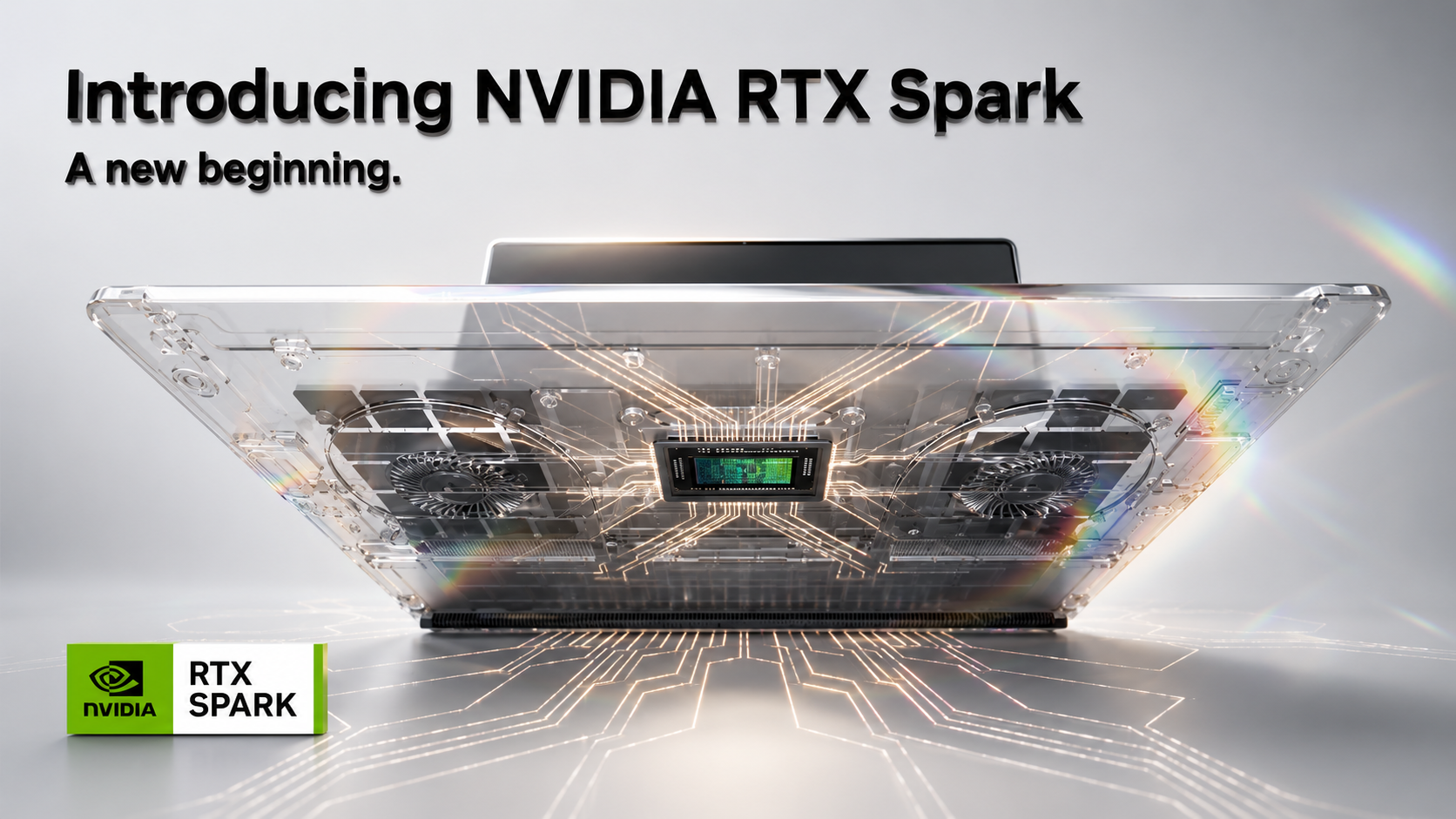
The hardware pitch centered on one new chip. NVIDIA introduced RTX Spark as a compact system built from what Huang called 33 years of NVIDIA learning, packed into a Windows PC platform meant for AI agents, creative work, and gaming.
These were the headline specs announced onstage:
| Component | Detail announced | Why it matters |
|---|---|---|
| GPU | Blackwell RTX GPU with 6,144 CUDA cores | Handles graphics and local AI workloads |
| AI performance | 1 petaflop | Gives the system far more local AI headroom |
| CPU | Custom 20-core Grace CPU, built with MediaTek | Pairs general compute with the GPU in one design |
| Interconnect | NVLink | Links CPU and GPU at high bandwidth |
| Memory | 128 GB of unified memory | Shares memory across AI, graphics, and system tasks |
| Manufacturing | TSMC 3-nanometer process, 70 billion transistors | Packs more capability into a laptop-class system |
The takeaway is clear: this is not a thin upgrade to an existing notebook chip. NVIDIA is trying to make a PC that can carry serious AI work locally, while still staying inside a Windows form factor.
Huang later referred to the chip as N1X, built with MediaTek. He also made a bold claim about software support. According to Huang, the full NVIDIA software stack runs on this machine, including CUDA workloads in fields such as biology, genomics, seismic processing, astrophysics, AI, and computer graphics. He also said the system runs Windows applications while adding support for agents on top.
That combination is the heart of the pitch. A powerful AI machine matters more when it doesn’t ask users to abandon the software they already rely on. On NVIDIA’s RTX Spark product page, the company positions the platform the same way: familiar Windows computing, but with much more local AI built in.
The new Windows model is old Windows plus large language models
The most interesting part of the keynote was not the silicon. It was Huang’s claim that the operating system itself now needs a new layer. He described the future PC as “the old operating system plus large language models.”
That line carries a lot of weight. Huang compared large language models to a modern version of DirectX. Years ago, DirectX gave developers a common way to tap graphics and multimedia features on the PC. In Huang’s framing, language models now do something similar for machine intelligence. They can take prompts as input, produce text and media as output, interpret images, generate video, and create sound.
In other words, AI becomes part of the platform, not a bolt-on feature.
He pushed the idea even further by saying the application itself is being replaced by an agent runtime. That does not mean traditional software vanishes overnight. The demos showed the opposite. Existing tools like Rhino, Blender, Photoshop, and Premiere still matter. What changes is how users interact with them. Instead of opening each program and doing every step by hand, you give an agent a goal, watch it use the tools, step in when needed, and let it continue.
NVIDIA’s launch video described this as a “Windows platform for agents.” The company said those agents can run natively, connect to local models or cloud models, stay sandboxed for security, and keep running continuously. Microsoft made the same case in its Windows overview of RTX Spark, which presented the collaboration as a new chapter for Windows PCs.
Huang also gave a glimpse of how flexible this model could be. A PC might run a local Nemotron 3 Ultra or Nemotron 3 Super model. At the same time, it could connect to cloud services such as Claude Code or Codex. That matters because it suggests a hybrid machine, one that can keep sensitive or fast tasks on-device while still reaching out to larger remote models when needed.
The house design demo made the case for local agents
The clearest example in the keynote was a house design workflow. It did more than show flashy AI output. It showed how NVIDIA thinks agents should work on a real PC, with real software, across several steps.
In the demo, an agent ran locally on RTX Spark through an open shell sandbox, using the Hermes harness while connecting to Claude Sonnet in the cloud. The user selected a site, shared concept sketches, added a mood board, and wrote a text prompt with the design goals.
From there, the agent took over much of the workflow on the laptop itself. It opened Rhino, modeled the site, shaped terrain, respected setbacks, and created the building envelope. Then it proposed building forms based on cost, comfort, and quality. After that, it generated the interior layout, including walls, room circulation, and room placement.
The key detail was not speed alone. The demo emphasized back-and-forth control. The user could step in at any time, make changes, and keep steering the project. Meanwhile, the agent placed doors, windows, and structural elements automatically. NVIDIA also showed the agent spotting its own mistakes and fixing them.
Once the design passed review, the agent exported the model from Rhino to Blender. Materials and object properties carried over with the design context intact. Then the user adjusted materials, chose camera angles, and let Blender render the house. A generative AI step using the Flux 2 model turned those renders into photoreal images across different viewpoints and lighting conditions.
That is a strong example because it stayed close to how creative professionals already work. The agent did not replace Rhino or Blender. It used them. That makes Huang’s larger argument easier to see. The future PC, in this vision, is not a sealed AI toy. It is a workstation that can plan, operate tools, recover from errors, and still leave room for human judgment.
Laptops, desktops, and workstations are all part of the same push
RTX Spark was introduced first as a laptop platform, and Huang made sure to tie it back to gaming. He showed clips of Forza and the upcoming 007 game, then called gaming the most beautiful part of the machine. That was classic NVIDIA, and it also mattered. The company is not treating AI as a replacement for graphics. It wants both in the same system.
Creative software got a similar spotlight. Huang said Adobe had re-engineered core parts of Photoshop and Premiere for RTX Spark, with performance up to twice as fast. He also said the tools were being made more agent-friendly through an MCP server, which would let agents interact with those applications on the laptop.
Then the keynote widened. Huang said Microsoft and NVIDIA are not only rebuilding laptops. They are rebuilding the full PC line, with three Windows machine categories: desktop, laptop, and workstation. He described all of them as fully Windows compatible, fully CUDA capable, and ready for NVIDIA AI Tensor Core workloads.
The desktop example, shown in an MSI chassis, was pitched as an always-on home AI system. Huang said it could run 24/7 without the cloud “meter anxiety” that comes from paying for constant remote compute. He imagined it connected to displays, cameras, home systems, and personal devices, growing more useful as newer Nemotron models arrive over time.
At the high end, he showed what he called a DGX Station for Windows. The specs were aimed at developers: 768 GB of memory, support for a trillion-parameter model, 20 petaflops of performance, and 8 TB per second of memory bandwidth. Huang’s pitch was direct. If you’re building large language models or agents, this is the kind of machine you keep beside your desk, then deploy to the cloud later.
The GTC Taipei keynote video also made clear that Huang sees this as the start of a broader category. He compared today’s PC moment to the old idea of a “phone,” which became something much bigger once smartphones took over. His prediction was that a future home may include an AI supercomputer that runs personal assistants and agents all the time, much like a game console, stereo, or home theater sits in a house today.
He even reached for science fiction, saying such systems may feel more like R2-D2 or C-3PO than the PCs people know now. That’s still a vision, not a finished reality. Yet it captures what RTX Spark is trying to be: less a faster laptop, more a first draft of a different kind of personal computer.
Where this leaves the Windows PC
The strongest idea from the keynote was not a benchmark. It was the claim that agents are becoming a built-in part of personal computing.
RTX Spark brings that claim down to hardware, with a new NVIDIA chip, a Windows software stack shaped for AI, and systems that range from laptops to heavy workstations. If Huang’s view holds up, the next important PC feature will not be another button or app. It will be a machine that can keep working beside you, using the tools you already know.