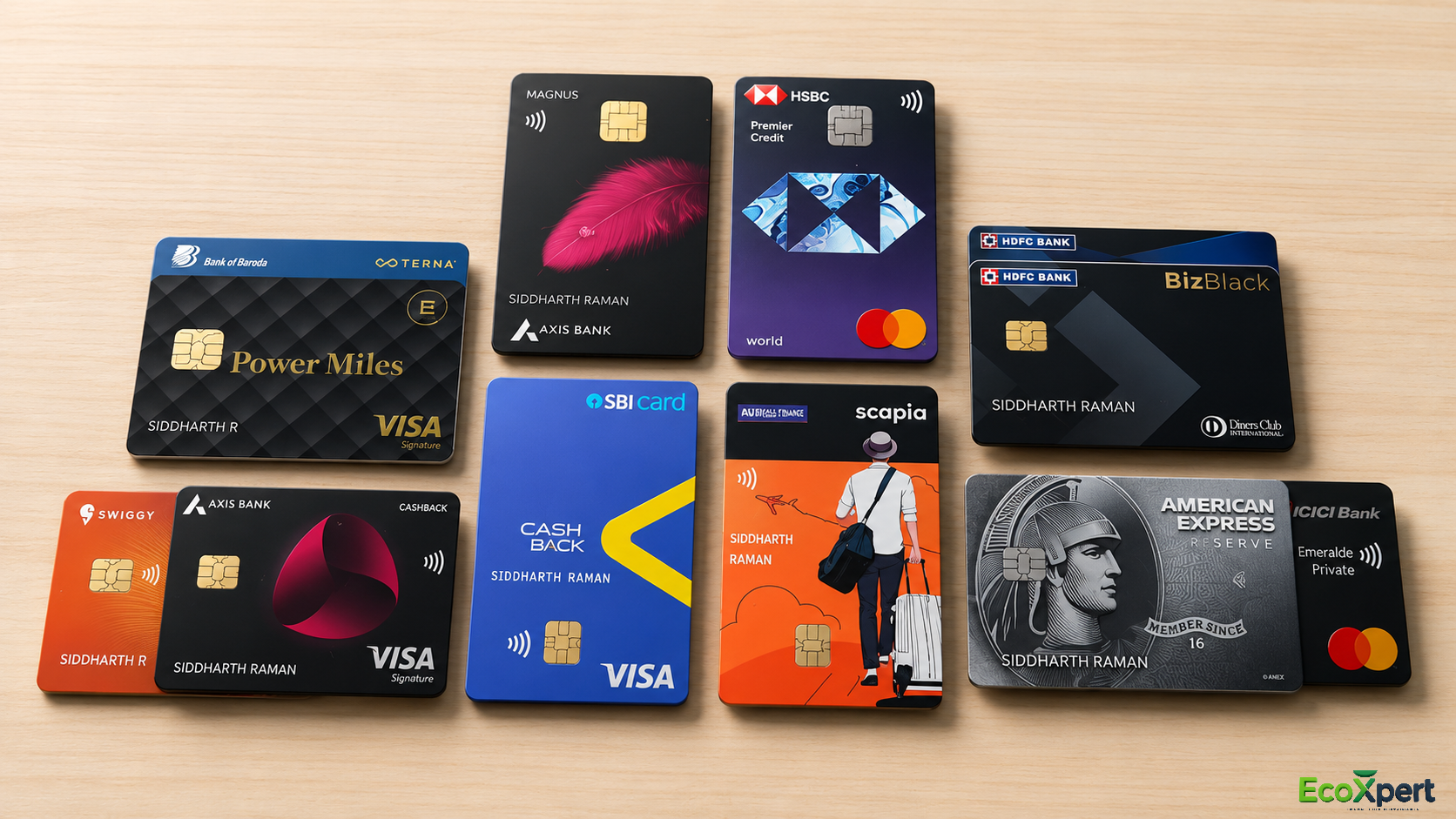
Picking a credit card in 2026 feels harder than it should. One bank flashes a big reward rate, another trims the benefits a few months later, and a card that looked perfect on paper can slip after a devaluation.
The cleanest way to judge a card is simple: match it to where your money goes. If most of your spending lands on online shopping, fuel, travel, Amazon, Swiggy, Tata Neu, or UPI, the shortlist gets much smaller.
That makes the category-wise view far more useful than a generic top-10 list.
The shortlist gets easier when you sort by spending pattern
A cashback card and a travel card may both look strong, but they solve different problems. The same applies to fuel cards. A driver who fills up at IndianOil every week doesn’t need the same card as someone who spends heavily on Swiggy or PhonePe.
Many of the names below also show up in wider roundups like Groww’s 2026 credit card comparison and CardExpert’s best credit cards for 2026, which isn’t surprising. These cards keep coming up because they fit clear spending patterns, not because they win every category at once.
All fees below are base fees. Add 18% GST to get the real annual cost.
This quick view sets the tone before the deeper breakdown.
| Spending pattern | Strong fit |
|---|---|
| General online shopping under ₹40,000 a month | SBI Cashback |
| Heavy online shopping above ₹40,000 a month | Axis Bank Cashback |
| Frequent Swiggy food and Instamart orders | HDFC Swiggy BLCK |
| Tata Neu app purchases and UPI scans | HDFC Tata Neu Infinity |
| PhonePe payments and app spends | SBI PhonePe Select BLCK |
| IndianOil fuel spends | RBL XTRA IndianOil |
| BPCL fuel plus some everyday categories | SBI BPCL Octane |
| Flights and hotel bookings | HSBC TravelOne |
| Premium travel and SmartBuy rewards | HDFC Infinia Metal |
| No annual fee | ICICI Amazon Pay, Federal Scapia |
That table is the short answer. The longer answer sits in the reward caps, the fee structure, and the places where each card is strongest.
Best cashback credit cards in 2026
Cashback is still the busiest category, and also the noisiest. Big percentages grab attention, but the real value comes from where the card pays, how much it caps each month, and whether the reward applies from the first rupee or only after a threshold.
SBI Cashback Credit Card
Even after multiple devaluations, SBI Cashback still holds its place near the top. The card carries a ₹999 joining fee, and the annual fee is also ₹999 from the second year onward.
Its core pitch is clean. You get 5% cashback on online spending and 1% on offline spending. The online cashback is capped at ₹2,000 per month, so the full cap is reached at about ₹40,000 of monthly online spend.
That simplicity is the reason this card remains so strong. There is no need to chase app-only categories or partner merchants. If you spend online across Amazon, Flipkart, food delivery apps, and regular shopping sites, SBI Cashback stays easy to understand and easy to use.
Axis Bank Cashback Credit Card
Axis Bank Cashback entered the conversation because of one flashy number: 7% cashback. That headline sounds bigger than SBI’s 5%, but the structure is more layered than the ads suggest.
The card has a ₹1,000 joining fee and a ₹1,000 annual fee, and the annual fee starts from the first year. Online cashback follows slabs. The first ₹5,000 of monthly online spending earns 2%, the next slab up to ₹40,000 earns 5%, and spending above ₹40,000 earns 7%. The total cashback cap is ₹4,000 per month.
This means the card doesn’t beat SBI Cashback for everyone. If your online spending usually stays below ₹40,000 a month, SBI’s flat 5% is cleaner and often stronger. On the other hand, if you regularly cross ₹40,000 in online spend, Axis becomes more attractive because the higher slab finally starts working.
HDFC Swiggy BLCK Credit Card
HDFC Swiggy BLCK is the specialist pick in this category. The joining fee is ₹1,000, and the annual fee is ₹1,000.
The headline benefit is 10% cashback on Swiggy app spending. That includes food orders, Dineout, and Instamart. Outside Swiggy, the card offers 5% cashback on online spending, capped at ₹1,500 per month, and 1% cashback on offline spending, capped at ₹1,000 per month.
For someone who already lives inside the Swiggy ecosystem, this card makes more sense than a general cashback card. For everyone else, it is still good, but the extra value comes from that Swiggy tie-up.
HDFC Tata Neu Infinity Credit Card
Tata Neu Infinity sits in two conversations at once. It works as a cashback card, and it also fits the best RuPay card discussion because of its UPI use case.
The card carries a ₹1,499 joining fee and a ₹1,499 annual fee. On the Tata Neu app, it offers up to 10% cashback, combining the app’s base value with the card-linked reward structure described in the discussion. That makes it strong for groceries, fashion, electronics, and other Tata Neu purchases.
It also pays 1.5% cashback on UPI scan-and-pay transactions when linked through the Tata Neu app, with a monthly cashback cap of ₹500. Add to that 8 domestic airport lounge visits and 4 international lounge visits in a year, and the card starts looking more rounded than a pure cashback tool.
If your spending already flows through Tata brands and UPI scans, this card does more than one job well.
SBI PhonePe Select BLCK Credit Card
SBI PhonePe Select BLCK has a ₹1,499 joining fee and a ₹1,499 annual fee. Its main hook is 10% cashback on PhonePe app spending. That can include recharges, bill payments, insurance, and other payments made inside PhonePe.
The card got hit by a devaluation effective July 1, 2026. The 10% cashback still exists, but the monthly cap is now split. Insurance payments can earn up to ₹500 in cashback a month, while the rest of the PhonePe ecosystem can earn up to ₹1,500. The total stays ₹2,000, but the flexibility is lower than before.
Other online spending earns 5%, and that monthly cap has also been reduced to ₹1,000. The card still includes 4 domestic lounge visits and 2 international lounge visits a year.
That makes SBI PhonePe Select BLCK more narrow now. It still works best for people who do a lot inside PhonePe itself, not for someone chasing broad online cashback.
Airtel Axis used to be one of the easy names in this category, especially for Airtel recharges and utility bills. After stricter conditions introduced from April 12, 2026, it no longer sits comfortably in this shortlist.
Best fuel credit cards in 2026
Fuel cards are much less about hype and much more about pump loyalty. The issuer tie-up matters because the reward rates are tied to specific fuel networks. For a wider look at pump-specific options, Paisabazaar’s fuel credit card roundup shows how quickly this category can shift.
RBL XTRA IndianOil Credit Card
RBL XTRA IndianOil is the sharper pick for people who care almost only about fuel savings. Its fee is around ₹1,500 a year, and its main feature is straightforward: 7.5% cashback at IndianOil fuel stations.
The monthly cashback cap is ₹1,000. That means the card reaches its ceiling at about ₹13,333 of monthly fuel spend. There isn’t much extra layering here, and that is the point. This card is built for one job.
If your regular fuel spend happens at IndianOil and you want the biggest direct percentage from that network, this is the cleaner choice.
SBI BPCL Octane Credit Card
SBI BPCL Octane costs ₹1,499 a year, and it brings a wider spread of benefits. At BPCL pumps, it offers 6.25% cashback on fuel, with a monthly cap of ₹625.
The card also gives 6.25% cashback on Bharatgas app spending, capped at ₹125 a month. In addition, it pays 2.5% cashback on dining, department stores, movies, and grocery spending.
That wider reach is what makes SBI BPCL Octane more flexible. The direct fuel reward is lower than the RBL IndianOil card, but the non-fuel categories help it stay useful even in a month when fuel spend is light.
So the split is simple. RBL XTRA IndianOil is better for pure fuel value. SBI BPCL Octane is better if you want fuel rewards plus some everyday savings around it.
Best travel credit cards in 2026
Travel cards live or die on redemption value. Lounge access looks nice, but the real question is how much value you get on flights and hotels after the points math settles.
HSBC TravelOne Credit Card
HSBC TravelOne is one of the strongest travel-focused cards in this lineup. The joining fee is ₹4,999, and the annual fee is also ₹4,999.
For flight bookings made through Yatra, EaseMyTrip, Paytm Flights, or Cleartrip, the card offers 19% cashback. On a ₹10,000 booking, that works out to about ₹1,900 in value.
Hotel bookings through the HSBC portal are where the card gets more interesting. The return is 24% in points, and those points can be converted to Accor at a 1:2 ratio. In simple terms, a ₹10,000 hotel booking can lead to 2,400 points, which can become 4,800 Accor points. That creates unusually strong hotel value for travelers who use Accor properties.
The card also includes 4 international and 6 domestic airport lounge visits a year. For a traveler who books flights and hotels often, HSBC TravelOne looks like a serious, focused tool.
HDFC Infinia Metal Credit Card
HDFC Infinia Metal sits in the premium tier. The joining fee is ₹12,500, and the annual fee is also ₹12,500.
The card includes one year of Club Marriott membership, some ITC hotel benefits, unlimited domestic and international lounge access, and unlimited golf lessons through the year. Those extras already place it in a different bracket.
Its reward value becomes even stronger through HDFC SmartBuy. Hotel, flight, bus, and train bookings through SmartBuy can return 33.33% in value. Purchases on brands like Amazon, Flipkart, Nykaa, Myntra, Tata CLiQ, and Blinkit through the same platform can return 16.5% in value.
This is not a casual travel card. It is a premium card with a premium fee, and it makes sense only when the user can extract value from hotel programs, lounge access, and SmartBuy redemptions.
Best lifetime free credit cards in 2026
A lifetime free card has one huge advantage: it doesn’t punish you for keeping it. That matters because a no-fee card can stay in your wallet for years and still pay off when used in the right places.
ICICI Amazon Pay Credit Card
ICICI Amazon Pay remains the standout in the lifetime free segment. There is no joining fee and no annual fee.
Prime members get 5% cashback on Amazon purchases. Non-Prime users get 3% on Amazon purchases. The card also offers 2% cashback on Amazon Pay partner spends and 1% on other spending.
One detail makes it better than it first appears. Flight and hotel bookings made through Amazon Pay also fall into the Amazon purchase bucket, so those can earn 5% for Prime users and 3% for non-Prime users, rather than only 2%.
That combination makes ICICI Amazon Pay unusually strong for a true no-fee card. In this category, few cards come close on simple day-to-day value.
Bank of Baroda Eterna Credit Card
Bank of Baroda Eterna is a bit different because its regular fee is ₹2,499 for joining and renewal. Still, it has been available as a lifetime free offer for a long stretch, and in that form it becomes much more interesting.
The card offers 3.75% cashback on online shopping, travel spends such as flights and hotels, and dining. The monthly cashback cap is ₹1,250. It also includes a one-year fitness membership benefit and gives 3.75% cashback on foreign-currency spending.
There is a 2% forex markup, so the effective net value on forex transactions works out to about 1.75%. That still makes it more useful than many ordinary cards for overseas spends.
When offered lifetime free, BOB Eterna turns into a strong travel-friendly and online-friendly option.
Federal Bank Scapia Credit Card
Federal Bank Scapia is another strong lifetime free card, especially for travelers. It charges no joining fee and no annual fee.
The card offers 2% cashback on online and offline spending. Through the Scapia app, hotel, flight, bus, and train bookings earn 4% cashback. It also carries 0% forex markup, which gives it a clean edge for international spending.
Domestic lounge access is unlimited, although there is a condition. The cardholder must spend ₹20,000 in the previous month to unlock lounge access for the next month.
That combination of no annual fee, travel-booking rewards, 0% forex markup, and lounge access makes Scapia one of the more useful lifetime free cards in this list.
The card that wins on paper may still lose in your wallet
The strongest takeaway from this 2026 lineup is simple. The best credit card is the one that matches your real monthly spending, not the one with the loudest headline reward.
SBI Cashback stays hard to ignore for broad online spending. HSBC TravelOne and HDFC Infinia Metal stand out for travelers. ICICI Amazon Pay and Federal Scapia keep the lifetime free category strong, while RBL XTRA IndianOil and SBI BPCL Octane cover fuel from two different angles.
Banks will keep changing caps, categories, and terms. Your spending pattern is the one number that stays honest.